

Living trends show that natural materials are returning more and more to the inside and outside of homes. The same is true of natural stone, which brings warmth and a homely feel to your home and its surroundings, along with many other advantages. Porcelain tile is one such material.
What is porcelain tile and how is it made?
It is a type of ceramic tile made from pressed clay with added natural minerals.
Porcelain tiles are made by pressing compact, non-porous clay and firing it for the right length of time at a very high temperature, about 1,200 °C.
During firing, the quartz sand molecules begin to turn into glass. They fill the gaps in the clay and make it even more durable and compact, and highly water resistant.
To be classed as porcelain, a tile must have a water absorption of less than 0.5 per cent.
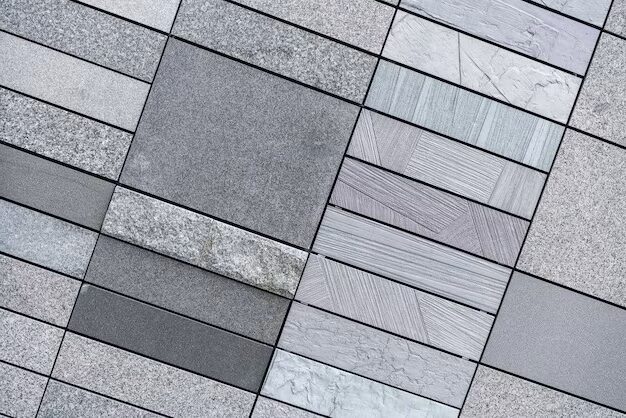
A porcelain tile differs from a ceramic tile in its surface, while the cross-section of its structure is exactly the same. You can choose a relief, polished, rough or textured surface in a wide range of effects.
Advantages of porcelain tiles
Porcelain tiles came onto the market in the 1980s. Thanks to their excellent properties, they are still one of the most popular floor and wall coverings today.
Their popularity is no accident. They combine durability, resistance and a well-finished look, which makes them an excellent choice for indoor and outdoor spaces.
One of the key advantages of porcelain is that it is very hard-wearing. Its resistance to mechanical damage and weather gives it a long life, so the tiles keep their look and function for years.
Because they resist moisture and changes in temperature, they are ideal for rooms with heavy use, such as hallways, bathrooms and kitchens. They are also an excellent choice for terraces, balconies and courtyards.
As well as being practical, porcelain tiles offer countless design options. They come in a wide range of colours, textures and sizes, so you can create an elegant, practical and pleasant space.
In recent years, development has focused mainly on imitating natural materials such as stone and wood. This gives you a refined look with all the advantages of ceramics.
Practicality is another reason why porcelain tile is so popular.
Its low water absorption makes it an excellent choice for damp rooms such as bathrooms and kitchens. It also resists chemicals and cleaning products, which makes it easy to maintain.
The tiles also come in different surface finishes, which give good slip resistance and safe use, even in wet areas.
Effects that imitate natural materials are also becoming more and more popular. A real wooden floor or wall covering in a bathroom, for example, would not be suitable at all, because it would be in constant contact with water and moisture.
It is also very hard today to tell a natural material from its imitation. The imitation is more durable and resistant, and it costs less than the natural material.
Uses of porcelain tiles
Thanks to their advantages, porcelain tiles are suitable for both floor and wall cladding, terraces, balconies, stairs, washbasins and kitchen worktops.
It is often used in public spaces with heavy footfall, such as hotels, shopping centres and offices. It is also found in laboratories and hospitals, because it is fully hygienic and resists chemicals. Because it is strong and wear resistant, it is also used in warehouses, workshops and factories.
Porcelain tiles are also very popular on building facades. Their variety makes many architectural ideas possible and gives a facade a modern, refined look.

In the past, porcelain tiles were designed purely for durability. Today people choose them mainly for the wide range on offer.
They come in many different colours, sizes and textures. So if you are looking for a material that combines good looks and function, porcelain tile is an excellent choice for your home, and Marnit stonemasons are the right people to ask.