Home / NATURAL STONE / Kitchen worktops
Kitchen worktops
The kitchen is the heart of every home, and the worktop is the part that works hardest. A stone kitchen worktop is more than a work surface. It is a work of art that will grace your home for many years. Natural stone stands for prestige and durability, so a stone worktop is an investment that pays off.
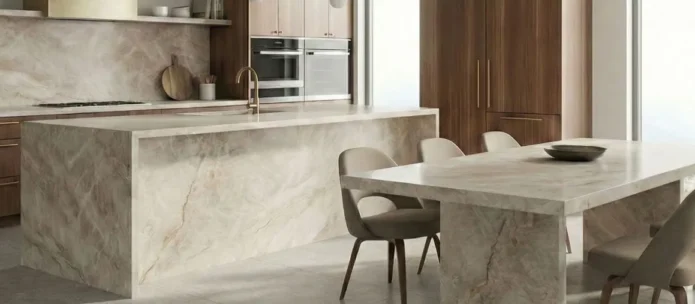
Taj Mahal
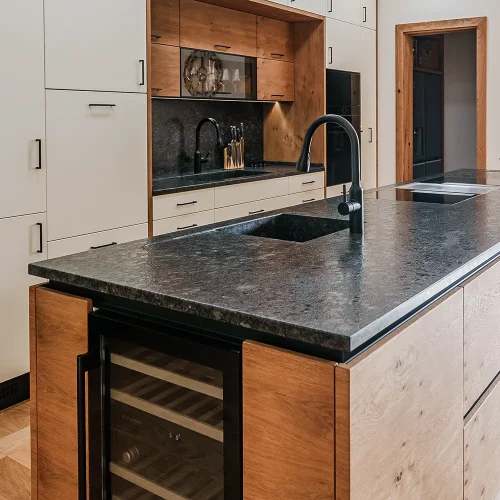
Steel Grey, brushed
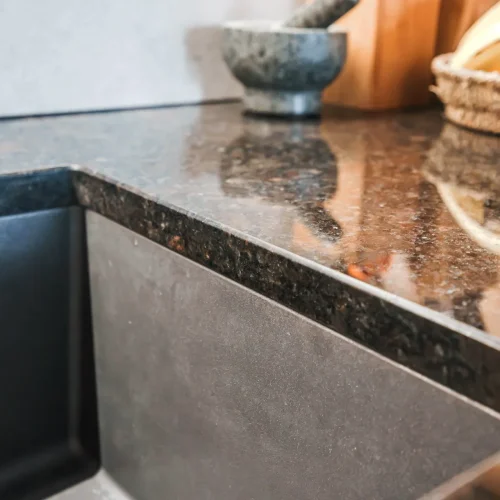
Undermount sink
Absolute Black
Colonial White
Beauty, durability and function in one
RESISTANCE
TO HEAT
A kitchen worktop must be tough enough to take a hot pan that you put down by accident. Natural stones such as granite and quartzite suit kitchen worktops especially well, because they take high temperatures without damage. Their natural properties make these stones heat-resistant, so you can put hot pots and pans on them without worry.
RESISTANCE TO WEAR AND SCRATCHES
Kitchen worktops are often in contact with sharp and heavy tools such as knives and heavy pots, so damage can happen. Avoid this loss in looks and value by choosing the most durable natural stones, such as granite and quartzite. Their dense mineral structure makes them highly resistant.
STAIN RESISTANCE
Fruit and vegetable juices, cooking oils, citric acid and other substances often get spilt in the kitchen. The material of your worktop must be able to withstand them. Because they do not absorb liquids, granite and quartzite are among the most popular natural stones for kitchen worktops.
NO SYNTHETIC MATERIALS
SUSTAINABILITY
Natural stone is an environmentally friendly material. It can be recycled and reprocessed, which supports sustainable development. As a fully natural material, it never becomes waste.
“Natural stone is a sustainable, hard-wearing material that adds to the look of any kitchen and suits every lifestyle. A natural stone kitchen worktop has a long life and is easy to clean and maintain. It also resists scratches, cuts and heat.”
You can also use natural stone for outdoor kitchens
Natural stone kitchen worktops are fully resistant to outdoor weather, such as changes in temperature, rain and snow, and UV rays. These will not damage your summer kitchen or change its colour.
Timeless elegance that never goes out of fashion
Discover the right natural stone slab for you
Natural stone is made of minerals that occur in nature. They create distinctive patterns that give the material its typical, elegant look. Every slab has its own veining and colour variations, so its beauty cannot be repeated. A wide range of colours and patterns is available to suit any design style.
Thicknesses
Slab thickness
2 cm | 3 cm
Finishes
POLISHED
A smooth, glossy surface.
BRUSHED
A gently textured surface that feels like leather.
*examples shown on Steel Grey
Sample gallery
Absolute Black
Absolute Black brushed
Amba Gold
Black Pearl
Blue in the Night
Brown Antique
Butterfly Blue
Calacatta Gold Quartz
Calacatta Grey Quartz
Coffee Brown
Coffee Brown brushed
Colonial White
ENQUIRY
Marnit d.o.o.
Miklavška cesta 53 B
2311 Hoče, Slovenia
Slovenia
+386 2 70 75 100
+386 31 612 266
info@marnit.si
prodaja@marnit.si
Thank you. We have received your enquiry.
We will reply as soon as we can.
We faced problems while connecting to the server or receiving data from the server. Please wait for a few seconds and try again.
If the problem persists, then check your internet connectivity. If all other sites open fine, then please contact the administrator of this website with the following information.
TextStatus: undefined
HTTP Error: undefined
Some error has occured.
FREQUENTLY ASKED QUESTIONS
CARE AND MAINTENANCE OF A STONE KITCHEN WORKTOP
Care differs from one type of natural stone to another. Granite and quartzite need very little care: a basic sealing that stops stains from soaking in is enough. Softer stones such as marble and limestone need sealing more often. We also advise careful everyday use. This means you lower the risk of stains: wipe spills off the surface as soon as you can and do not leave them to stand. Because these stones are softer, sharp objects can leave scratches over years of use.
WHAT TEMPERATURE CAN A NATURAL STONE KITCHEN WORKTOP TAKE?
A natural stone kitchen worktop in granite, marble or quartzite can take high temperatures, but the resistance depends on the stone:
Granite: very heat-resistant, 300 °C
Marble: more sensitive than granite, but still takes heat up to 200 °C.
Quartzite: similar to granite, takes temperatures up to 300 °C.
All of them resist heat well enough for home use (putting down hot pans).
THE DIFFERENCE BETWEEN NATURAL STONE AND CERAMICS
It is hard to generalise about the differences between natural stone and ceramics, because they depend on the stone you choose. Natural stone (the harder stones we recommend for kitchen worktops) and ceramics work in very similar ways, but they differ in some respects. Here is a comparison, point by point:
LOOK
- Natural stone offers distinctive patterns and colours, because every slab is formed by nature. This makes your natural stone kitchen worktop one of a kind. Natural crystals and minerals also give the material a sense of depth that you see from every side.
- Ceramics can be very adaptable, with a wide range of colours, patterns and textures. Ceramic slabs can be made to look like natural stone, concrete, wood…, but the patterns repeat, which can make each piece feel less individual. Because the surface is printed, the pattern does not show on the edges or on the back of the material.
DURABILITY
- Natural stone, in its harder types (granite, quartzite…), resists heat, scratches, damage and stains very well. Softer stones (marble, limestone…) are more sensitive to scratches and acid stains, but the right care and maintenance prevents this or reduces the risk. Every natural stone needs a first sealing, which we carry out before the worktop is fitted. How often you need to seal it again depends on the stone.
- Ceramics are hard-wearing and resist scratches, stains and heat. Ceramic tiles need no special care, but a very hard knock on an unsupported edge can damage them.
PRICE
- Natural stone: prices vary a lot with the type of stone. It can cost more or less than ceramics.
- Ceramics also come in a wide price range. The price depends on the quality and on how realistic the print looks. As a rule, prices from the same manufacturer depend on the texture, not on the look of the surface. A matt finish costs less than a polished one. Special finishes and 3D textures can cost even more.
DIMENSIONS, THICKNESSES AND FINISHES
- Natural stone: slab sizes vary, up to 180 × 320 cm. Kitchen worktop slabs are usually 2 or 3 cm thick, but can be thicker. Every stone can have a polished or brushed finish.
- Ceramics:
- Slabs are 160 × 320 cm. The usual thickness is 12 mm, but 20 mm is also possible (recommended only when the worktop has long, unsupported overhangs). Finishes: matt, silk/satin and polished.