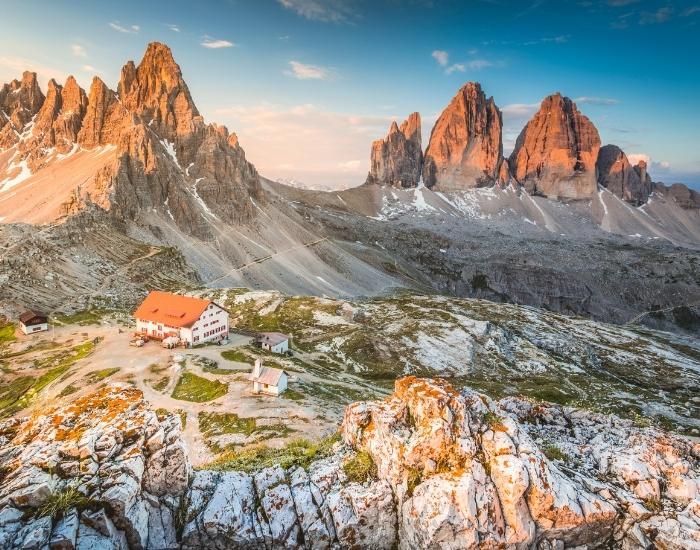
The difference between limestone and dolomite
You have surely heard of limestone. But what about dolomite? Both are sedimentary rocks that make up a large part of Slovenia's surface. In this article we explain the basics of each rock, compare them and look at the differences and similarities.
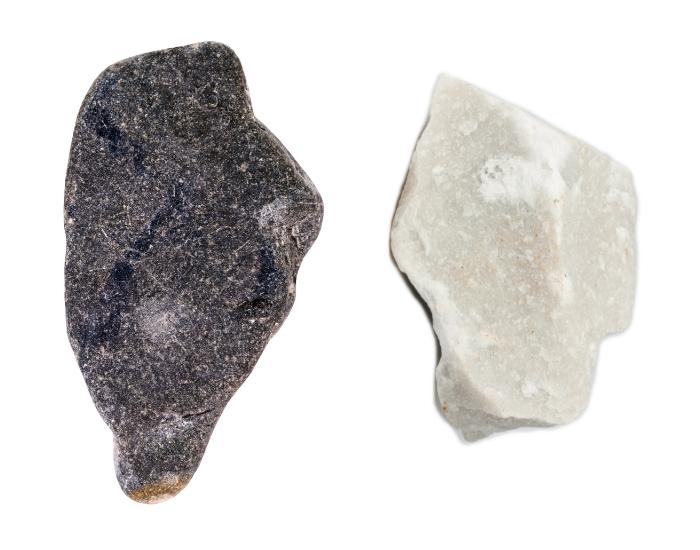
Limestone is a sedimentary rock made up mainly of calcite, a calcium carbonate mineral (CaCO3). Dolomite is also a sediment of carbonate rock and a crystalline mineral. Both are made up of calcium magnesium carbonate CaMg(CO3)2. Dolomite rock consists mostly of the mineral dolomite.
How did limestone and dolomite form?
In the Mesozoic era, warm shallow seas were teeming with life. Snails, shellfish, corals, echinoderms, plankton and other organisms used CaCO3 from seawater to build their shells and bones. When these organisms died, the waves broke them down and carried them to the ocean floor, where they were compressed over millions of years. The remains of the carbonate skeletons built up in layers, and under the great pressure of the strata these deposits turned into solid carbonate rock. This is how limestone forms.
Dolomite also forms when calcium magnesium carbonate minerals precipitate from saturated seawater and settle on the earth's surface. Dolomite does not precipitate at normal temperatures and pressures.
One of the ways it forms is from limestone during diagenesis. Diagenesis is the process that describes the changes in a sediment from the time it is deposited until it hardens into sedimentary rock, and all the later changes the solid rock goes through because of changes in temperature and/or pressure. The diagenetic change of limestone into dolomite is called dolomitisation. It can happen right after the sediment is deposited or much later in the solid rock.
Tectonic movements lifted these sedimentary rocks out of the sea. Today we know them as limestone and dolomite, the rocks that form the basis of karst and karst features.
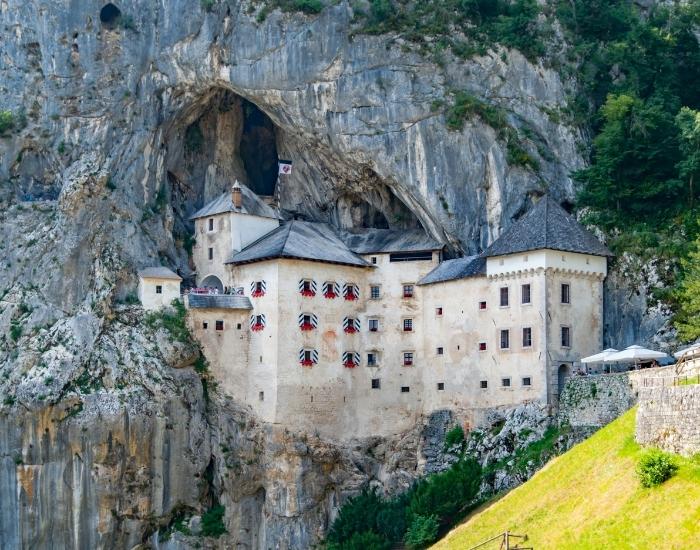
The most common rocks in Slovenia
Sedimentary rocks dominate in Slovenia and cover as much as 93 per cent of its surface. The most common are limestone and dolomite, which cover as much as half of the surface. Metamorphic rocks cover 4 per cent and igneous rocks 3 per cent of Slovenia's surface.
How to tell limestone and dolomite apart
Limestone and dolomite have a lot in common, as well as some differences. How do you tell them apart? With a 10 per cent hydrochloric acid solution. Limestone reacts strongly with the acid, foaming and fizzing, while dolomite does not react.
The table below compares the two rocks in detail.
| Limestone | Dolomite | |
| Formula | CaCO3 / calcium carbonate | CaMg(CO3)2 / calcium magnesium carbonate |
| Hardness | 3 | 3,5-4 |
| Density | 2.6–2.8 g/cm3 | 2.9/3.0 g/cm3 |
| Lustre | vitreous | vitreous, also pearly |
| Mineral | the mineral calcite | the mineral dolomite |
| Occurrence | a widespread rock, in places forming entire mountain ranges | a widespread rock, in places forming entire mountain ranges |
| Rock type | sedimentary rock | sedimentary rock |
Uses of limestone and dolomite
Limestone is durable, resistant and non-slip, so it is often used in construction. It is used for road foundations, buildings, paving and landscaping, and to make lime. It is also popular in architecture.
Dolomite has many uses too. It is used as an ornamental stone, to make concrete and as a source of magnesium oxide. In its pure form this stone is an ideal raw material used in industry to produce magnesium metal. It is also often found in the production of light alloys. In horticulture it is used to neutralise acidic soil.